
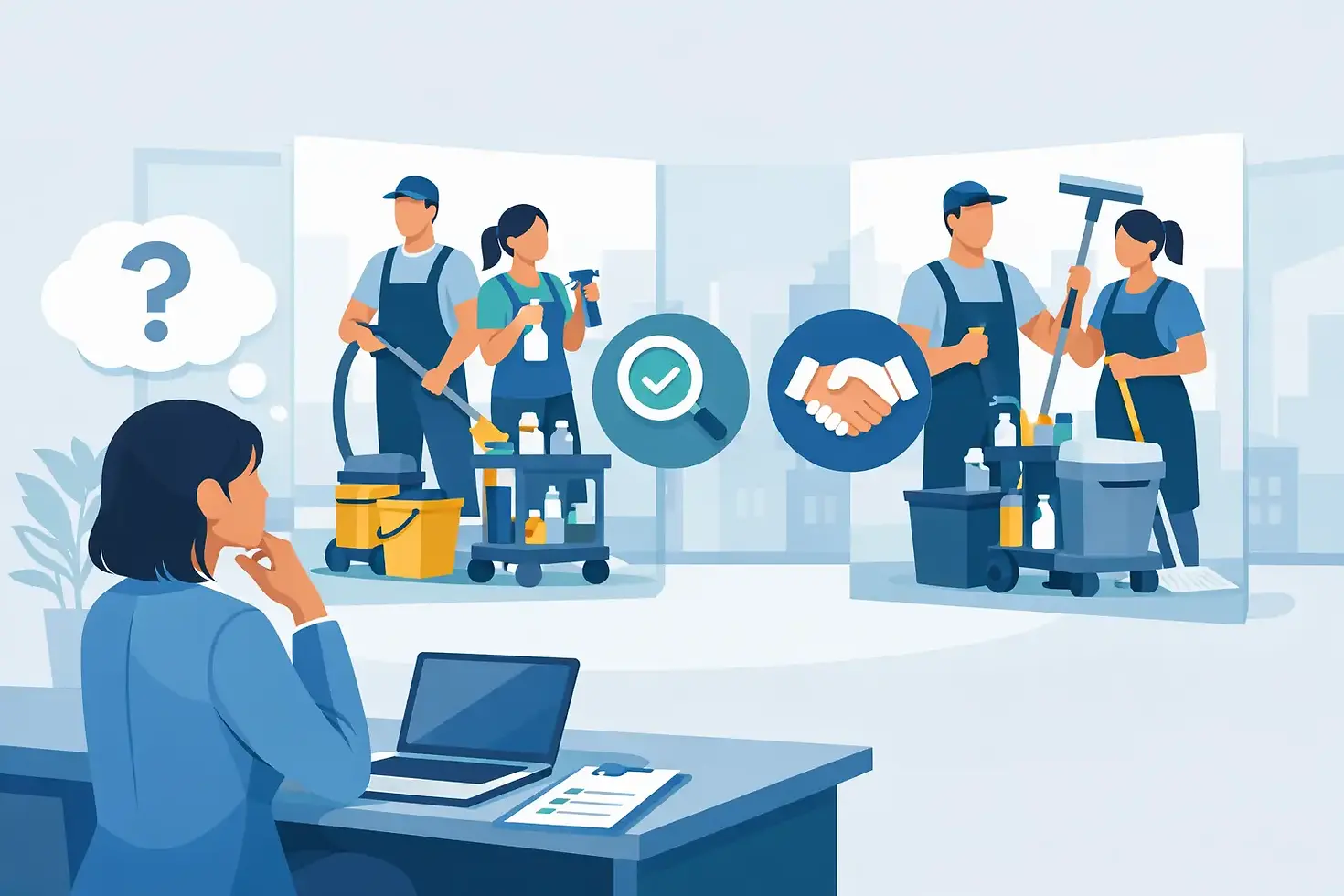
How to Choose Commercial Cleaning Vendors

A missed service window, a vague scope, and one avoidable insurance issue can turn a routine maintenance contract into a management problem fast. That is why knowing how to choose commercial cleaning vendors matters well before the first proposal lands in your inbox. For property managers, HOA boards, REIT operators, and facility teams, the right vendor does more than clean a site. They protect appearance, reduce friction, and help keep the property inspection-ready.
The mistake many teams make is treating vendor selection like a simple price comparison. On paper, two bids may look similar. In practice, one provider may be organized, accountable, and built for commercial work at scale, while the other is just selling labor hours with very little structure behind them.
How to choose commercial cleaning vendors without buying headaches
The strongest commercial cleaning vendors are rarely defined by a low number on a proposal. They are defined by how well they understand your asset, how clearly they define scope, and how consistently they execute across recurring service cycles.
Start by looking at fit before price. A vendor that performs well on a small retail pad may not be equipped for a multifamily portfolio, an HOA community, or a large mixed-use property. Commercial work requires scheduling discipline, documented processes, site-specific planning, and crews that can operate professionally around residents, tenants, staff, and visitors.
That is especially true when you are managing multiple exterior and preventive maintenance categories at once. If your needs include pressure washing, window cleaning, gutter service, roof cleaning, dryer vent cleaning, or trash chute cleaning, the operational burden increases quickly when each task is assigned to a separate contractor. In those cases, a broader maintenance partner can create better consistency, fewer communication gaps, and cleaner accountability.
Define the scope before you compare vendors
If your bid request is too broad, the responses will be hard to compare. One vendor may include detailed surface preparation, debris removal, safety controls, and reporting. Another may leave those items out and still appear less expensive.
A better process starts with clarity. Identify the exact service areas, cleaning frequencies, access limitations, timing requirements, and performance expectations. If the property is occupied, spell out hours, resident sensitivity, noise restrictions, and staging limitations. If board presentation or inspection readiness matters, include that as part of the expected outcome.
This does two things. First, it gives vendors less room to hide behind assumptions. Second, it helps you see who asks smart operational questions. Strong vendors usually push for detail because they know details affect quality, staffing, safety, and price.
Evaluate commercial experience, not just capability
A vendor may be able to perform the work. That does not mean they are the right commercial partner. There is a difference between technical ability and commercial readiness.
When evaluating experience, look for a track record with property types similar to yours. A vendor serving HOAs and multifamily communities understands resident communication, common area access, recurring maintenance scheduling, and the importance of visible consistency. A vendor working with commercial campuses or industrial properties should understand safety expectations, site protocols, and the need to coordinate with facilities teams.
Ask how they manage larger properties, multi-building sites, or recurring schedules across a portfolio. Ask who supervises the work and how issues are escalated. If the answers are vague, the operational structure may be weak.
A seasoned provider should be able to explain their process in plain terms. Not just what they clean, but how they assess, schedule, document, and follow through.
Insurance, licensing, and compliance are not box-checks
This is one area where shortcuts get expensive. If a vendor is working on roofs, near pedestrian areas, around occupied buildings, or using specialized equipment, insurance and compliance need to be verified carefully.
Do not stop at asking whether they are licensed and insured. Confirm coverage levels, workers' compensation status, and whether the policy aligns with your property's requirements. If your organization requires additional insured endorsements or specific documentation, bring that up early.
The right vendor will handle this professionally and promptly. The wrong one will act like documentation is a hassle. That attitude usually shows up elsewhere too, in scheduling, communication, and quality control.
Look closely at how they inspect and manage quality
One of the best indicators of a dependable vendor is how they define a completed job. If the answer is simply that the crew finishes and leaves, that is not enough for commercial maintenance.
Quality control should be visible in the proposal and in the conversation. Who checks the work? Are site photos provided when appropriate? How are punch items handled? What happens if a board member, tenant, or property owner flags a concern after service?
Reliable vendors have a repeatable system for this. They do not rely on good intentions. They rely on process.
This matters even more with recurring service. The first visit may look strong because leadership is involved. The real test is month three, quarter two, or the middle of peak scheduling season. If there is no inspection process behind the service, quality usually drifts.
How to compare pricing when choosing commercial cleaning vendors
Learning how to choose commercial cleaning vendors also means learning how to read pricing beyond the total. The cheapest proposal can become the most expensive if it excludes key tasks, under-staffs the work, or creates repeated callback issues.
Look for line-item clarity where possible. You want to know what is included, what is excluded, what assumptions were made, and what could trigger change orders. If a vendor gives a very low number without much detail, they may be pricing to win rather than pricing to perform.
At the same time, the highest price is not automatically the best value. Premium pricing only makes sense when it is backed by stronger planning, better service controls, and lower execution risk. The goal is not to buy the lowest bid or the highest bid. It is to buy confidence.
A useful question is this: what are you actually paying to avoid? Delays, missed details, resident complaints, safety exposure, poor communication, and constant vendor management all have a cost, even if they do not show up on the proposal.
Communication should feel organized from the start
You can learn a lot about a vendor before the work begins. Did they arrive prepared for the site visit? Did they ask practical questions? Was the proposal clear and timely? Did they follow up with answers, or did communication slow down once they submitted pricing?
Commercial property teams do not need hand-holding, but they do need responsiveness and structure. A vendor should know who owns the account, how service is scheduled, where updates go, and how urgent issues are handled.
This is where strong providers separate themselves. They reduce management burden instead of adding to it. Outdoor Keepers built its commercial maintenance approach around that standard because large properties need dependable execution, not constant chasing.
Favor vendors that can scale with your property needs
For many commercial properties, cleaning is not a one-off event. It is part of a larger preventive maintenance strategy. Today it may be pressure washing and gutter cleaning. Next quarter it may be window cleaning, roof treatment, solar panel cleaning, or dryer vent service.
A single-service vendor can still be the right fit in some cases, especially for highly specialized work. But if you are managing a complex site or a broad portfolio, there is real value in choosing a provider with wider service capability. Fewer vendors means fewer site walks, fewer invoices, fewer scheduling conflicts, and a more unified standard of care.
That does not mean breadth should replace quality. The better question is whether the vendor can perform multiple services well, with the same level of professionalism and oversight.
References matter, but process matters more
References can be helpful, especially when they come from similar property types. Ask about consistency, responsiveness, and whether the vendor solves problems without creating new ones.
Still, references alone are not enough. Every vendor can find a happy customer. What protects you is a provider with clear process, strong documentation, commercial-grade insurance, defined supervision, and a proposal that reflects a real understanding of your site.
If you are deciding between two decent options, choose the one that makes risk feel lower. Choose the team that communicates clearly, defines scope carefully, and treats your property like an asset that needs protection, not just a job to complete.
The right vendor relationship should make your operation calmer, your site cleaner, and your standards easier to maintain. If a provider can deliver that before the contract starts, there is a good chance they will still be delivering it long after the first service date.


Comments