
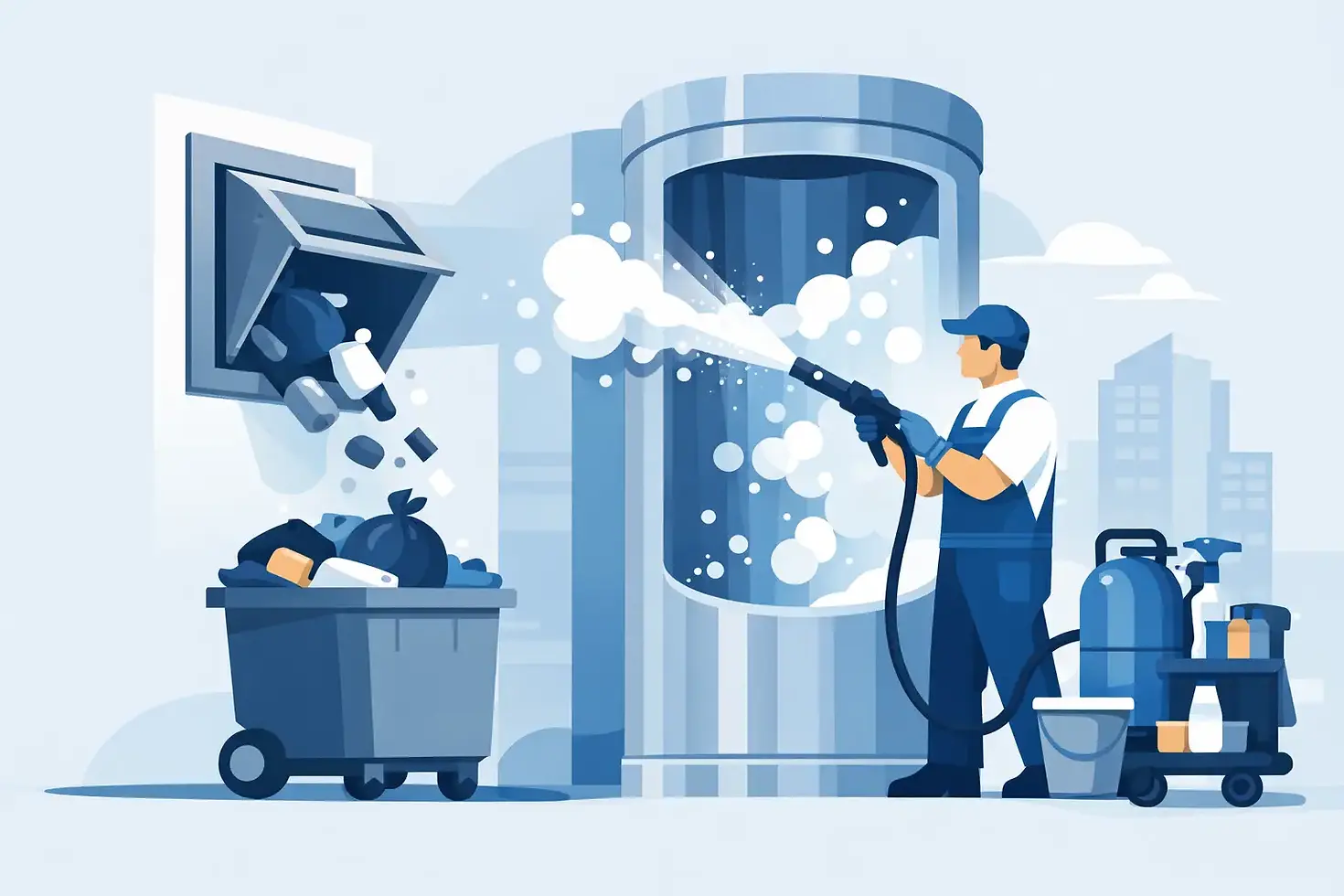
Trash Chute Cleaning Services That Hold Up

When residents start complaining about odors on multiple floors, the chute is usually the real issue - not the dumpster room alone. Trash chute cleaning services address the grease, residue, bacteria, and debris that collect inside the chute system over time, and for multifamily and commercial properties, that buildup can quickly turn into a sanitation problem, a resident satisfaction issue, and an avoidable maintenance headache.
For property managers and facility teams, the challenge is rarely deciding whether the chute needs attention. It is deciding how to handle it without disrupting operations, creating liability, or settling for a surface-level clean that does not hold up. In high-traffic buildings, especially apartment communities, condominiums, senior housing, and mixed-use properties, chute systems take constant abuse. Food waste leaks. Liquids drip through seams. Bags tear. Odors settle into every interior surface. If the service scope is not thorough, the problem comes right back.
What trash chute cleaning services should actually include
A proper chute cleaning service should go far beyond spraying deodorizer into the shaft. The objective is to remove buildup, sanitize the chute interior, clean intake doors, and address the supporting areas that affect cleanliness and odor control, including the compactor room or collection area.
That starts with a site-specific assessment. Not every property has the same chute height, access conditions, usage level, or service schedule. A garden-style apartment community with moderate traffic needs a different approach than a dense high-rise with heavy daily volume. The best service providers account for the number of floors, chute material, visible buildup, wash-down requirements, and whether the property also needs pressure washing or cleaning in adjacent service areas.
The cleaning itself should target the interior walls of the chute, not just the entry points. Grease, food residue, and sticky debris cling to the full vertical run. If that layer is left behind, bacteria and odors return quickly. Intake doors also matter. Residents touch them constantly, and they often collect splash-back, grime, and stains. In many buildings, the discharge area needs equal attention because that is where runoff, leakage, and persistent odor problems often concentrate.
Why routine trash chute cleaning services matter
Waiting until a chute smells bad is a costly way to manage the system. By that point, residue is usually well established, and the issue has already become visible to residents, staff, or inspectors. Routine trash chute cleaning services support a more controlled maintenance standard.
The biggest benefit is sanitation. Chute interiors are dark, enclosed, and constantly exposed to organic waste. That creates ideal conditions for bacterial growth and persistent odor. Regular cleaning reduces contamination and helps keep the building environment more manageable, especially in shared residential settings where even one problem area can affect the perception of the entire property.
There is also the issue of resident experience. In multifamily communities, chute rooms are high-frequency touchpoints. If they smell neglected, residents assume the property is being managed reactively instead of proactively. That perception spreads fast. Clean, well-maintained waste systems help reinforce a higher operating standard across the property.
For HOA boards, REIT operators, and commercial owners, inspection readiness is another practical reason to stay ahead of chute maintenance. Sanitation complaints, housekeeping concerns, and deferred cleaning can all raise questions about property oversight. A recurring service schedule helps avoid last-minute scrambling when standards need to be demonstrated.
The risks of delaying chute cleaning
Odor is the most obvious symptom, but it is rarely the only one. Once waste residue accumulates inside a chute, it can attract pests, stain interior surfaces, and create a more difficult cleanup later. Small issues become larger service events because the buildup hardens, spreads, or begins affecting adjacent spaces.
There is also an operational trade-off. Some managers postpone service to avoid coordinating access or tenant notifications. That can make sense in the short term, but it usually leads to a more disruptive job later. A system that receives routine maintenance is easier to manage and less likely to require intensive corrective cleaning under pressure.
In buildings with higher resident density, delay can also increase complaints and staff time. Leasing teams, maintenance technicians, and front office staff often end up fielding odor concerns that all trace back to the same avoidable source. Preventive service reduces that noise and keeps onsite teams focused on broader property operations.
How to evaluate a provider for trash chute cleaning services
For commercial and HOA-managed properties, this is not a commodity service. The right provider needs to be organized, insured, responsive, and capable of working within active building operations. A vendor that handles small residential jobs may not be prepared for large-scale communities, access coordination, or recurring property-wide service expectations.
Look first at service reliability. You want a provider that can define scope clearly, show up as scheduled, and document what was completed. That matters even more if your property is part of a portfolio and vendor accountability is being measured across multiple locations.
Experience with managed properties is also critical. Multifamily, HOA, and commercial environments require a different level of communication and planning than one-off service calls. Tenant notice requirements, access restrictions, sanitation protocols, and after-hours scheduling all affect execution. A provider that understands those realities is easier to work with and less likely to create friction for your onsite team.
It also helps to work with a company that can coordinate chute cleaning alongside other preventive maintenance services. Waste system sanitation is connected to overall property presentation and operational care. When one qualified partner can handle related exterior and building maintenance needs, scheduling becomes simpler and service quality is easier to standardize.
How often should trash chute cleaning services be scheduled?
It depends on building use, resident behavior, and the type of waste moving through the system. A smaller property with light usage may be fine on a quarterly or semiannual schedule. A larger multifamily building, senior living property, or high-density condominium may need monthly or bi-monthly attention to stay ahead of odor and residue.
The wrong approach is assuming all properties can follow the same calendar. Frequency should be based on actual traffic and observed conditions. If odors return quickly, if the intake doors are consistently soiled, or if the collection area needs repeated cleanup, the interval is probably too long.
A customized schedule is usually the most cost-effective option. Over-servicing wastes budget. Under-servicing creates repeat problems, resident frustration, and higher corrective cleaning costs. The best maintenance plans match the building, not a generic service menu.
What organized service delivery looks like
Good chute cleaning is not just about the wash process. It is also about coordination. That means clear communication before service, appropriate timing for occupied buildings, site protection during the cleaning process, and follow-through after the work is completed.
For larger communities and commercial sites, professionalism shows up in the details. Was the scope reviewed in advance? Were access needs handled properly? Did the provider work in a way that minimized disruption for residents and staff? Was the service completed thoroughly, not rushed through to meet a low price point?
That level of execution matters because chute cleaning sits at the intersection of sanitation, resident experience, and operational standards. It is not glamorous work, but it directly affects how the property performs day to day.
For many managed properties, this is why working with an established maintenance partner makes more sense than chasing the cheapest available vendor. Outdoor Keepers approaches chute cleaning the same way it approaches broader preventive maintenance - with a focus on quality, consistency, and property-specific execution that supports long-term asset care.
Trash chute cleaning services as part of preventive maintenance
The most effective properties do not treat chute cleaning as an isolated task. They treat it as part of a larger maintenance system designed to preserve cleanliness, reduce complaints, and support inspection-ready conditions. That is where real value shows up.
When trash chute cleaning services are scheduled proactively, managers gain more than a cleaner shaft. They gain better control over sanitation standards, fewer recurring odor issues, and a more dependable experience for residents, board members, ownership groups, and site staff. They also avoid the cycle of reactive service calls that tend to cost more and deliver less.
If your property relies on a shared chute system, the question is not whether it will need professional cleaning. It is whether the service will be scheduled early enough, and performed well enough, to keep the problem from reaching your residents first. A clean chute system is one of those quiet maintenance wins that most people only notice when it is being neglected.


Comments